





Digital Intelligence Reconstructs Manufacturing Industry: AI Drives Comprehensive Upgrade of Industrial Intelligent Manufacturing
Artificial intelligence (AI) is profoundly influencing the underlying logic of the manufacturing industry. From policy guidance to corporate practices, AI has moved beyond the proof-of-concept stage and is gradually permeating every aspect of research and development, production, management, and supply chain, becoming a significant force driving industrial transformation and upgrading.
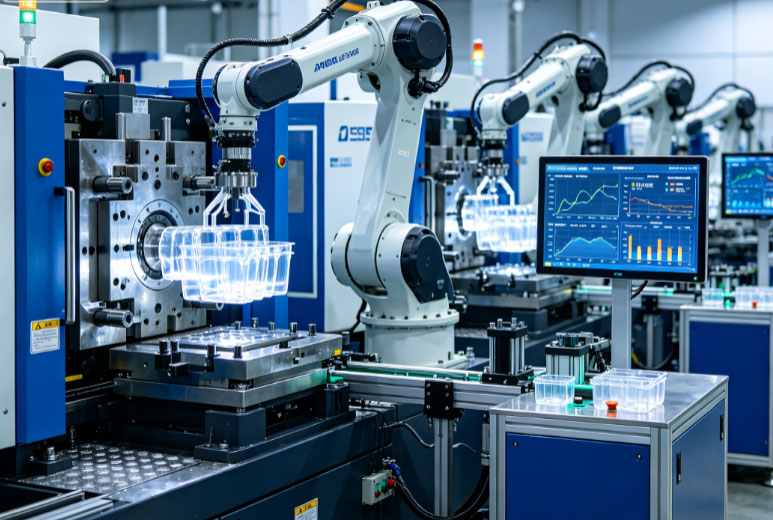
1. Key application scenarios of AI in manufacturing
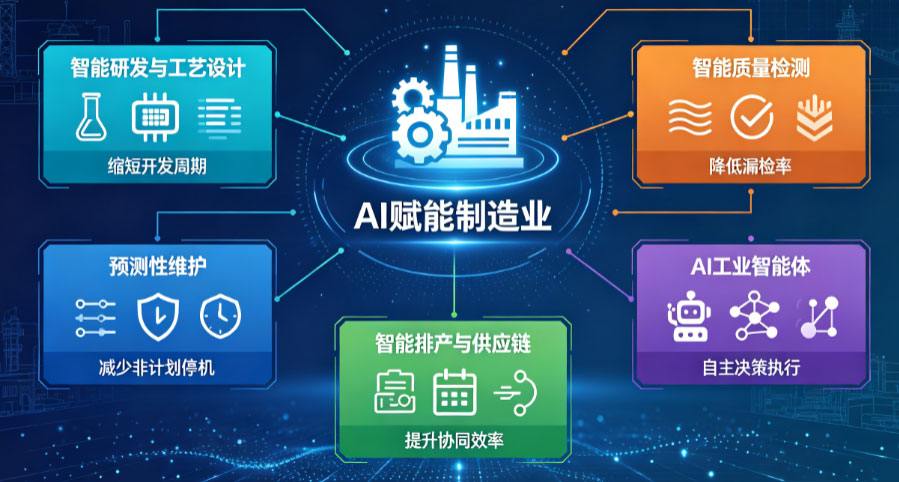
AI technology has covered the entire lifecycle from product development to after-sales service, unlocking measurable value in multiple business aspects.
1. Research and Development (R&D) and Process Design
In the product development stage, AI simulation and data analysis technology are transforming the traditional development model that relies on expert experience and repeated trial and error. Through deep learning of vast amounts of process data and material properties, AI can assist engineers in predicting the process adaptation effect and finished product performance, transforming implicit experience into quantifiable digital logic. In practical applications, the model's prediction accuracy can reach a high level, effectively reducing the workload of repeated experiments and ineffective verifications, and shortening the new product development cycle.
2. Intelligent quality inspection
AI visual inspection has gradually become a standard means of quality control in manufacturing. Relying on the intelligent inspection architecture featuring "end-edge-cloud" collaboration, the system can perform fully automated screening of product appearance, dimensions, and defects, capturing subtle flaws that are difficult for human eyes to identify. Compared to traditional manual sampling inspection, AI inspection effectively addresses pain points such as fatigue, inconsistent standards, and missed inspections, significantly reducing the missed inspection rate and ensuring the consistency and stability of product quality.
3. Predictive maintenance of equipment
Predictive maintenance is a relatively mature application direction for the implementation of industrial AI. By deploying smart sensors on key equipment to collect real-time operational data such as vibration, temperature, and current, AI models can identify abnormal equipment states and issue early warnings before failures occur. This has shifted equipment maintenance from "post-event emergency repairs" to "pre-event prevention", effectively reducing the loss of production capacity and delivery delays caused by unplanned downtime.
4. Intelligent production scheduling and supply chain collaboration
Facing a market environment characterized by multiple varieties, small batches, and frequent fluctuations in orders, AI scheduling algorithms can comprehensively consider multiple constraints such as machine load, mold status, material inventory, delivery cycle, and energy consumption cost, automatically generating dynamically optimized production plans. Coupled with the establishment of an industrial data platform, enterprises can integrate the entire information flow from market demand, procurement to delivery, enhancing the response speed and flexibility of the supply chain.
5. AI Industrial Intelligent Agents and Future Factories
AI industrial intelligent agents can be understood as "digital employees" equipped with perception, decision-making, and execution capabilities. The distinguishing feature of these agents is their ability to achieve collaborative operations across different scenarios and processes. From research and development, production, to warehousing and management, the large-scale application of intelligent agents is driving the evolution of factories from automation to autonomy, representing an important exploration direction for future intelligent manufacturing.
II. Quantitative value in practice
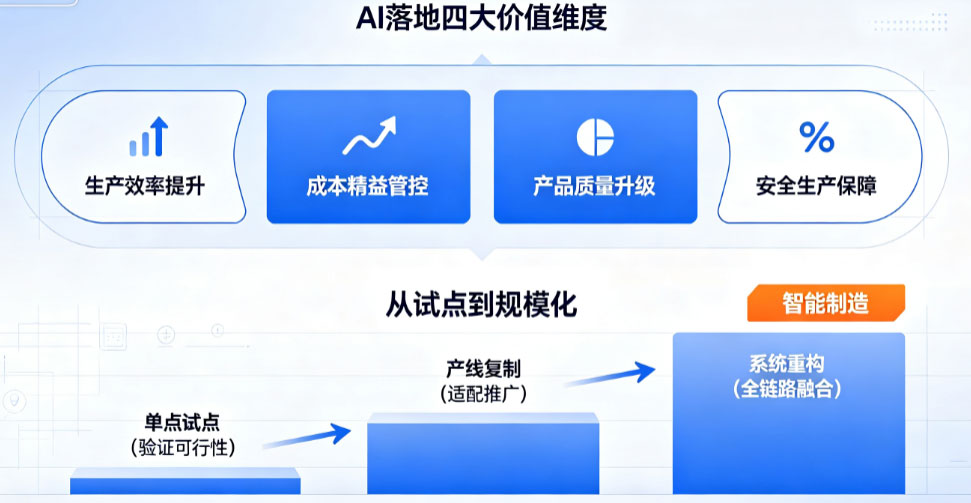
Based on the industry cases that have been implemented, the empowering effect of AI is mainly reflected in four aspects: production efficiency, cost control, quality assurance, and safe production.
Improved production efficiency. Through optimizing process integration, streamlining non-value-added links, and enhancing decision-making timeliness, AI has helped factories significantly shorten production cycles. Some leading enterprises have achieved substantial improvements in production efficiency after completing full-chain intelligent transformation. Cost and risk control. Lightweight AI tools have played a practical role in scenarios such as workshop inspections, hidden danger identification, and operational standards, helping enterprises to promptly detect on-site risks and reduce safety accidents. This not only reduces hidden costs but also strengthens the safety defense line.
Product quality improvement. AI has demonstrated its value in both discrete manufacturing and process manufacturing. In the former, it is reflected in intelligent detection and interception of defective products, while in the latter, it is reflected in dynamically optimizing process parameters to improve product yield and capacity utilization.
(Note: The above effectiveness data comes from publicly available industry cases. The actual implementation results may vary depending on factors such as the enterprise's equipment foundation, data quality, and management level, and are for reference only.)
III. Challenges faced in promotion implementation
The large-scale adoption of AI in manufacturing still faces unavoidable challenges.
The difficulty of large-scale replication is relatively high. According to industry observations, many enterprises have achieved good results during the pilot phase, but when it comes to replicating and promoting to more production lines and factories, they often encounter the problem of "not fitting in". Technical solutions need to be adapted to different on-site environments, rather than simply being installed as standardized products.
Data governance and talent shortage. Data silos are prevalent in industrial sites, where raw data lacks a complete business context and model training lacks high-quality datasets. At the same time, the supply of composite talents who understand both production processes and AI technology is insufficient, which restricts the speed and quality of technology implementation.
IV. Industry Outlook
The integration of AI and manufacturing is moving from shallow applications to deep restructuring, and the following directions are worth paying attention to.
From single-point pilot to full value chain coverage, AI applications are extending from individual processes to the entire chain of research and development, production, supply chain, and service, systematically reshaping the operational methods of manufacturing enterprises.
Policy guidance continues to gain momentum. According to the "Opinions on Implementing the Special Action of 'Artificial Intelligence + Manufacturing'" issued by the Ministry of Industry and Information Technology, the goal is to cultivate a group of high-level industrial intelligent entities by 2027, providing clear policy guidance for the intelligent upgrading of industries.
Corporate investment continues to increase. Under the dual influence of market competition and policy promotion, manufacturing enterprises have continuously increased their investment in digital and intelligent infrastructure, creating conditions for the in-depth application of AI.
Conclusion
Artificial intelligence is transforming the operational methods of the manufacturing industry. It is not merely a tool to enhance the already good, but rather a crucial tool to address bottlenecks in efficiency, quality, and innovation. The landscape of AI-enabled manufacturing has begun to emerge, and its practical value in improving efficiency, reducing costs, and enhancing quality has been verified through quantifiable means.
For manufacturing enterprises, embracing AI does not mean blindly chasing technological concepts. Based on their current business status, it is a feasible path to move from traditional manufacturing to intelligent manufacturing by formulating systematic plans, gradually carrying out pilot projects, verifying, and then replicating and promoting them