





Artificial intelligence empowers the injection molding industry: transitioning from experience-driven to data-driven
1. Industry pain points and opportunities for change
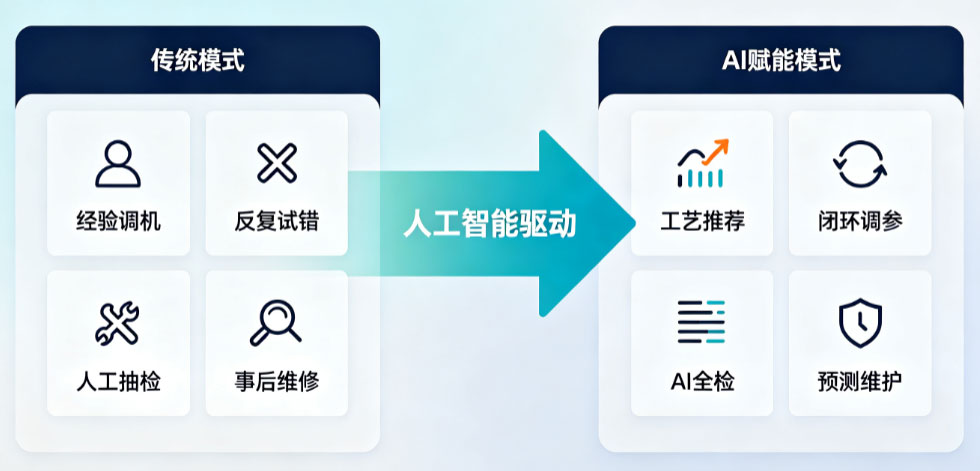
Injection molding is the core processing technology for plastic products, widely applied in various fields such as automotive, home appliances, medical, packaging, and 3C electronics. For a long time, injection molding production has been highly dependent on the personal experience of frontline operators: there are numerous combinations of process parameters, and production conditions are complex and variable. The stability of product quality largely depends on the technical proficiency of the machine adjustment technician. Process knowledge is scattered in the minds of personnel, lacking systematic accumulation, making it highly susceptible to the problem of "skills being lost with personnel turnover". At the same time, the long cycle of new product process development and parameter debugging, coupled with high trial and error costs, has become a core bottleneck restricting the industry's quality improvement and efficiency enhancement.
As sensor technology, industrial IoT, machine learning, and other technologies gradually enter the industrial field, the injection molding industry is undergoing an industrial upgrade from "experience-oriented" to "data-driven" and then to "model-empowered". The value of artificial intelligence lies in transforming tacit knowledge that relies on personal experience into standardized process capabilities that can be quantified, replicated, and iteratively optimized, thereby systematically solving the aforementioned industry challenges.

II. Key Applications of AI in Injection Molding Production
AI technology has penetrated into multiple aspects of injection molding production, with its implementation achievements evident in process design, production execution, quality control, and equipment operation and maintenance.
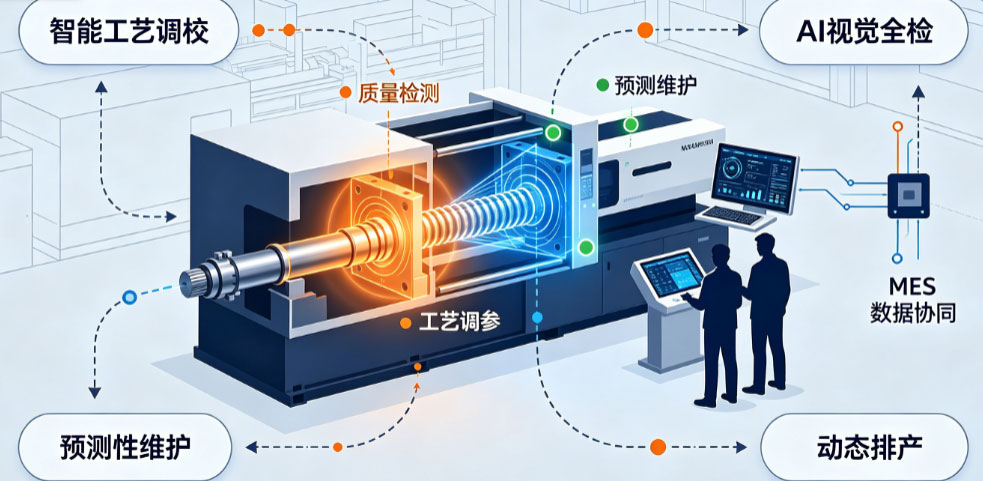
1. Intelligent adjustment of process parameters
Under traditional production models, whenever changing molds or raw material batches, engineers need to repeatedly debug parameters, consuming a significant amount of time and materials. AI can learn from and accumulate historical production data, construct a process parameter recommendation model, and automatically output initial parameter suggestions when launching new products.
In the production and operation phase, the system achieves millisecond-level automatic compensation and fine adjustment by frequently collecting key process curves such as melt pressure and injection speed, in response to working condition deviations such as raw material viscosity fluctuations and environmental temperature changes. From practical application, this mode can shorten the debugging cycle by more than half, while effectively reducing the scrap rate and minimizing the waste of raw materials and energy. More importantly, the experienced technicians' years of tuning experience are solidified into digital assets of the enterprise, no longer relying on individual inheritance.
2. Equipment health management and predictive maintenance
Unplanned downtime of injection molding machines is a significant factor leading to delivery delays and increased costs. Based on the fusion analysis of multi-sensor data such as vibration, temperature, and current, AI can construct a device health assessment model to predict the lifespan trends of key components such as screws, heating rings, and hydraulic components, and issue potential failure warnings 2 to 3 days in advance.
By integrating data with the MES system, early warning information can directly trigger preventive maintenance work orders and adjust production schedules accordingly, avoiding the passive situation caused by unexpected downtime. In the practices of some leading enterprises, the unplanned downtime rate has been reduced by more than 40%, and the overall equipment efficiency has been improved to around 85%.
3. Intelligent upgrade of quality inspection
The traditional manual inspection method has limited efficiency and a high rate of missed inspections, making it difficult to meet the quality control requirements for precision injection molded parts. The AI visual inspection system based on deep learning can conduct comprehensive appearance screening of products, accurately identifying various defects such as burrs, missing material, sink marks, and black spots, with an accuracy rate of over 99.9%, achieving a leap from spot inspection to full inspection.
Crucially, when the system detects a defective product, it can automatically trace back to the raw material batch, mold status, and complete process curve at the time of production. Leveraging AI algorithms, it can pinpoint the root cause of defects and provide reverse guidance for process correction, forming a closed-loop management of "detection-analysis-optimization". Coupled with a traceability system where each item is assigned a unique code, enterprises can achieve full-process quality tracking from raw materials to finished products, shifting quality management from post-interception to process control.
4. Dynamic optimization of production scheduling
Facing the practical challenges of fragmented orders, frequent mold changes, and continuous order insertions, traditional manual production scheduling methods struggle to accommodate multiple constraints. AI scheduling algorithms can comprehensively evaluate factors such as mold lifespan, machine tonnage, color switching sequence, delivery priority, and energy consumption costs, automatically generating optimal production plans.
In the event of equipment malfunction or urgent order insertion, the system can complete the recalculation of the production scheduling plan within minutes, and coordinate with the pre-production preparation and material distribution processes, effectively reducing the waiting time for mold change and improving the order fulfillment rate.
III. Realistic challenges faced in promoting the implementation of AI
Despite the proven technical value of AI, there are still several practical barriers to its large-scale promotion in the injection molding industry.
The data foundation is uneven. The communication protocols of injection molding machines and auxiliary equipment from different brands are not unified, and the cost of retrofitting old equipment for data collection is relatively high. AI model training requires a large amount of high-quality, fully labeled production data, but many small and medium-sized factories do not yet have such data conditions.
Integrating software and hardware poses challenges. Modules such as AI vision and predictive algorithms require deep integration with MES systems, equipment PLCs, and various sensors. It is not as simple as purchasing a set of software and directly using it. This process demands strong project implementation capabilities and extensive industry experience.
There is an insufficient reserve of composite talents. There is a scarcity of composite technical personnel who understand both injection molding processes and digital tools, which can easily lead to the dilemma of "not knowing how to use or using poorly" after the system goes online.
We need to adopt a rational attitude towards earnings expectations. The above-mentioned performance indicators are derived from the practical achievements of leading enterprises. The actual results are influenced by multiple factors such as the equipment status, management level, and personnel execution ability of the enterprise, and cannot be directly achieved just by going online.
IV. Industry Outlook: From Single-Point Application to System Integration
Looking ahead, the intelligent evolution of the injection molding industry will exhibit several clear directions.
Deep integration of AI and MES. AI will not operate as an isolated tool, but will be deeply integrated with the MES (Manufacturing Execution System) - MES undertakes data aggregation and business process management, while AI is responsible for data mining, predictive analysis, and optimization decision-making. The two complement each other, jointly building an intelligent workshop operation system.
Application scenarios are extending upstream. The capabilities of AI are being extended from production execution to front-end R&D areas such as mold process simulation and product manufacturability analysis, intervening in quality and efficiency optimization at earlier stages.
Lightweight solutions for small and medium-sized enterprises. In response to the actual situation of numerous small and medium-sized injection molding enterprises, the industry is developing AI tools with low entry requirements and easy deployment. By reducing the complexity of data collection and model usage, more enterprises can enjoy the technological dividends.
Conclusion
Artificial intelligence is reshaping the production logic of the injection molding industry. From intelligent process parameter adjustment, visual full inspection, to predictive maintenance and dynamic scheduling, AI is driving the gradual transformation of injection molding production from a "craftsmanship" relying on personal experience to a standardized and scientific production driven by data.
For injection molding enterprises, the smart transformation should not blindly pursue the latest trends. A more pragmatic approach is to combine their own equipment conditions, order structure, and management status, use MES as the workshop data foundation, introduce AI capabilities as needed, address real business pain points step by step, and steadily advance the evolution from manufacturing to smart manufacturing.